

Malaysia: The next leg of the journey..
Suddenly we were in Malaysia - one of those places, a bit like Indonesia, I knew absolutely nothing about. If you had asked me to point out Malyasia on a map of the world, I definitely would not be sure, and I knew nothing of the food, the cities, the culture etc - but it did, somehow feel familiar. I'm not sure why.
Maybe it goes back to Military Brat days, (Child of serving uk Military parent) when other army kids talked about places with exotic-sounding names — Malaya, Malacca, Singapore, Borneo etc. Places their parents had been posted to, or where they had lived before arriving wherever we happened to be living at the time.
I don’t remember consciously thinking, one day I’m going there. But perhaps some of those names lodged themselves somewhere in the back of my mind and now, all these years later, here we were — sailing into Malaysia
Throughout its history, Malaysia has been ruled and influenced by many different groups, and this seems to have shaped the country we see today — particularly the food and the people. There is even a name for the distinctive culture that grew from the blending of Chinese and Malay influences — Peranakan, with the women traditionally known as Nyonya and the men as Baba.
The word Nyonya crops up all over the place — in the food, the shops, the traditional costumes etc. As an outsider I find it so interesting.
Back in the day, what we now know as Malaysia, was made up of various Malay Kingdoms each governed and ruled by individual Sultans (A sort of King)
Due to its strategic position on the spice-trading route between the East and West, it became a major centre for international trade- attracting merchants from China, India, Arabia and all across Southeast Asia - many eventually settling here helping to create the beautiful and extraordinary mix of cultures, religions and food that characterises Malaysia today,.
Later on - us Europeans had to poke our noses in, starting with the Portugese taking control in the 1500's followed by the Dutch, then eventually us Brits, who took permanent control in 1824 leaving the Dutch to concentrate their influence in what became Indonesia Over the following century. British influence gradually spread across much of what is now Malaysia.
With the onset of world war 2, in December 1941, Japanese forces invaded British Malaya from the north, advancing down the Malay Peninsula and capturing Singapore in February 1942. Malaya and Singapore remained under Japanese occupation for the next three and a half years. As with so many wars, it was a brutal period, with severe hardship and atrocities inflicted on the civilian population — particularly the ethnic Chinese community — as well as appalling treatment of Allied prisoners of war. Following Japan’s surrender in August 1945, the British returned and resumed control of Malaya
The years following the war, leading up to Malaysia’s independence in 1957, were marked by some of the most intense violence and conflict in the country’s history . Known as the Malayan emergency, the fighting was primarily between communist pro-independence fighters of Malaya who wanted to establish a communist state and the Malayan Federation, who were against communism and wanted to protect British economic/colonial interests. Troops were supported from Great Britain, Australia, the Gurkhas, New Zealand, Kenya, Fiji and Rhodesia.
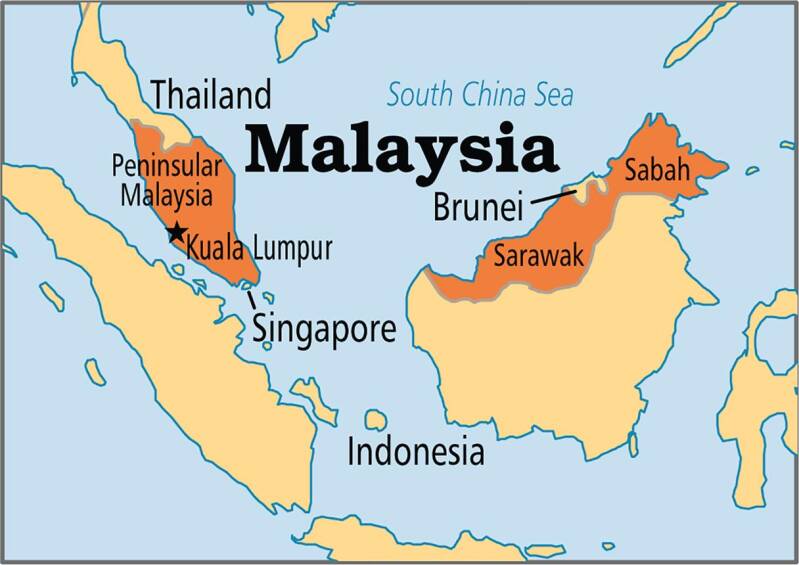
The Federation of Malaya ( which was essentially the peninsula ) became independent from Britain in 1957, to then merge with Borneo, Sarawak, Sabah and Singapore to create a new country - Malaysia
After considerable tension, Singapore parted ways with Malaysia and became the independent Republic of Singapore in 1965, which it remains today.
Malaysia continued without Singapore — a country in two pieces, sitting just above the equator in Southeast Asia and separated by 600 km of the South China Sea, with Peninsular Malaysia on one side and Malaysian Borneo on the other.
The Singapore Strait is the narrow stretch of water between the Indonesian islands and Singapore — for centuries a gateway between East and West, once notorious for pirates and the spice trade, and today one of the world’s busiest shipping routes.
We entered Malaysia via a place called Johor Bahru (Or JB as the locals call it) which is just over the river, but a few miles north of Singapore. To get here, there is no way of avoiding the Singapore Straits. And suddenly, here we were, in the thick of it! Basically crossing the M25 in rush hour - in a boat. Thats what it felt like anyway.
Obviously I was wetting myselt. My husband, however, switched into full pilot mode without missing a beat — glued to the VHF radio, calmly weaving us through the madness like it was a Sunday sail. He bloody loved it!
He had it all in hand, so I decided my talents were not required and better used elsewhere - I scurried off below and decided to make some fishcakes. Like you do.
I did brave the deck once or twice, but those mahooooosive floating skyscrapers charging by gave me a panic attack and sent me scuttling straight back to the galley.
I think we all know there is a huge amount of stuff coming from China — not only my rather extensive Temu deliveries, but enormous tankers and cargo ships carrying everything from containers to millions of barrels of oil.
This is where AIS — Automatic Identification System — comes in. Basically, air traffic control for boats. Vessels transmit their position, course and speed, which means the Port Authorities can keep track of who is coming and going and, more importantly for us anyway, we can see the other boats — and they can see us.
Even when we're miles offshore with nothing but horizon in every direction, AIS will warn us that there's a ship approaching long before we can see it. We know where it is, which way it's heading and whether we need to tweak our course.
And here is what that AIS looks like when you're trying to cross the Singapore Strait to get from Indonesia to Malaysia…
The green triangles are generally mahoosive tankers and we are the little red boat.

The Singapore Straits

